The Eau Gallie founding, 1860s
How a Reconstruction-era Florida official named William H. Gleason picked a stretch of pine flatwoods on the Indian River and put a town on it before Melbourne had a post office.
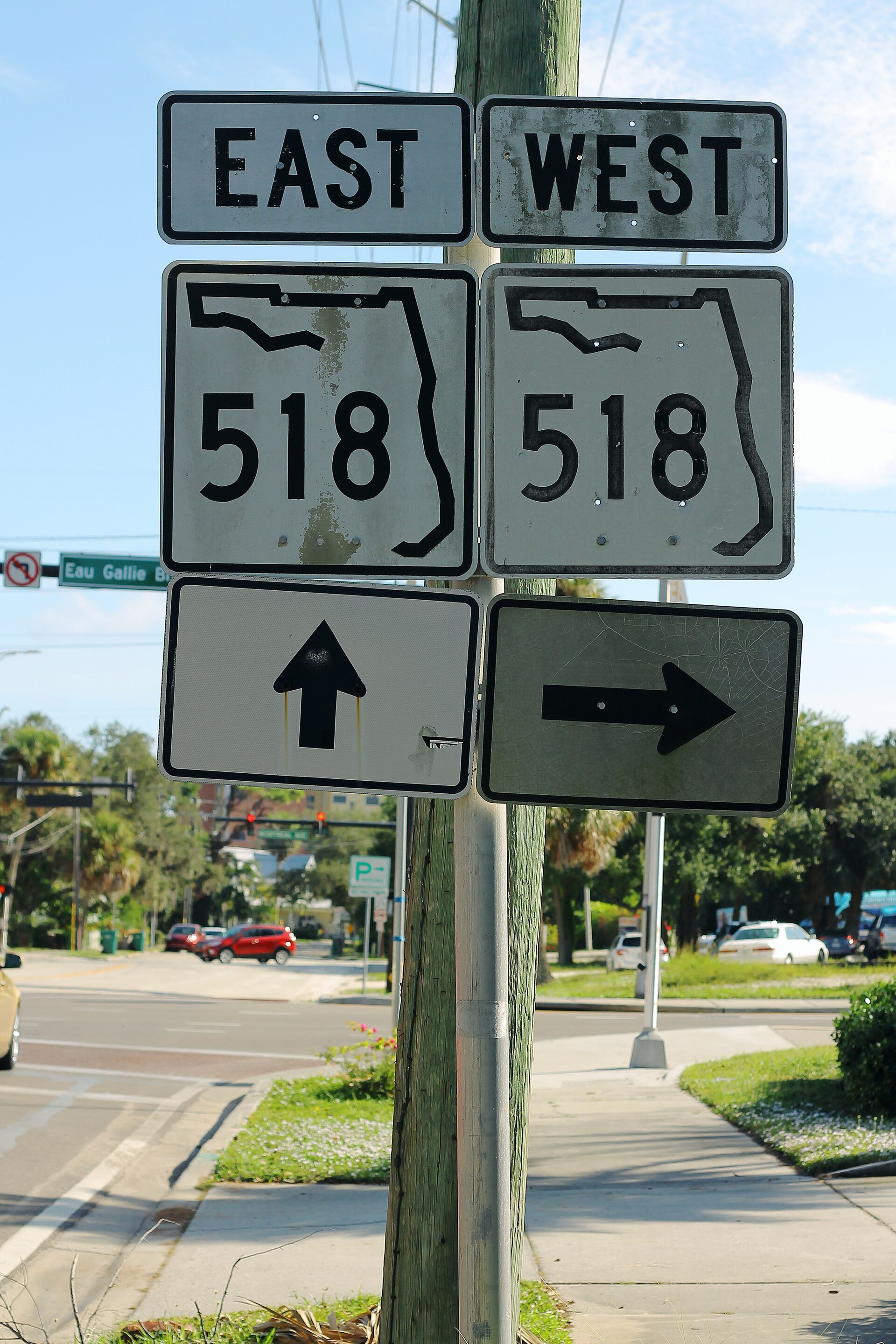
Eau Gallie predates Melbourne by about a decade. The settlement was founded in 1860 by a Massachusetts-born Florida official named William H. Gleason, who picked a stretch of high pine flatwoods on the west bank of the Indian River, north of what would later become Crane Creek, and named it for the rocky bottom of the creek that drains into the lagoon there. “Eau Gallie” is a hybrid: French eau (water) plus a Choctaw or Mvskoke word commonly rendered as galli or gali, meaning rocky or stony. Roughly: “rocky water.” The name is recorded in the 1860 plat Gleason filed with the territorial land office.
That’s the headline. The full story involves Gleason’s startling political career, a botanic-garden venture that nearly worked, and a thirty-year run as a standalone city before the 1969 merger with Melbourne.
William H. Gleason
Gleason is one of those Reconstruction-era Florida figures who get a Wikipedia paragraph and not much more. He deserves longer treatment. Born in Richford, New York, in 1829, he worked first in engineering and banking, helped develop the city of Eau Claire, Wisconsin in 1855, and arrived in Florida in 1865 as a special agent for the Freedmen’s Bureau, sent to scout the state as a possible site for an African American agricultural colony. He recommended against the colony, a decision that earned him political credit with the white-Republican faction that controlled Reconstruction Florida.
On July 7, 1868, he became Florida’s second lieutenant governor under Harrison Reed. When the Florida House moved to impeach Reed later that same year, Gleason claimed the governorship outright, set up an office in a Tallahassee hotel, and signed documents as governor. The Florida Supreme Court sided with Reed. Gleason was removed from office on December 14, 1868, on a residency-eligibility ruling. He held the second-highest seat in the state for barely five months.
Gleason had bought up parcels along the Indian River during his time as a federal agent. The verified primary figure (per the Wikipedia entry citing his land patents) is approximately 16,000 acres acquired at $1.25 per acre, with a plat covering roughly thirty square miles between the Indian River Lagoon and Lake Washington. The Eau Gallie tract was the headquarters parcel.
The reason this matters: Eau Gallie’s founding wasn’t a homesteader’s tent like Hector’s at Crane Creek. It was a planned land-development venture by a politically connected speculator with deep ties to federal patronage. Gleason picked the site for what it could be sold as, not for what it already was.
The 1871 Agricultural College proposal
The most ambitious thing Gleason tried at Eau Gallie was an agricultural college. In 1871 he proposed and won state designation for what would have been Florida’s first land-grant agricultural college, donating 2,320 acres of his Eau Gallie holdings to anchor the campus. Construction began. A college building went up. The institution operated briefly on the Eau Gallie site before politics and a stronger competing bid from the central Florida town of Lake City pulled the institution north. The agricultural college relocated to Lake City in 1884, eventually evolving into what became the University of Florida.
What survived on the Eau Gallie campus was the building. Gleason and his sons converted the former college structure into the Hotel Granada during the 1890s, running it as a winter-tourist hotel through the boom years of FEC arrival. The hotel burned in 1902. Gleason died the same year, on November 8, 1902, at age 73. His son George Griffin Gleason carried on the family land business until his own death in 1918 from pneumonia following the Spanish flu.
The agricultural college that almost was, and the eventual University of Florida that grew from its successor, is one of the more interesting counterfactuals in Brevard history. Had the 1884 relocation gone the other way, Eau Gallie rather than Gainesville would be a university town, and the post-1969 Melbourne metropolitan area would have a very different anchor institution than the FIT campus that filled the educational role much later.
The Eau Gallie River and the rocky-water etymology
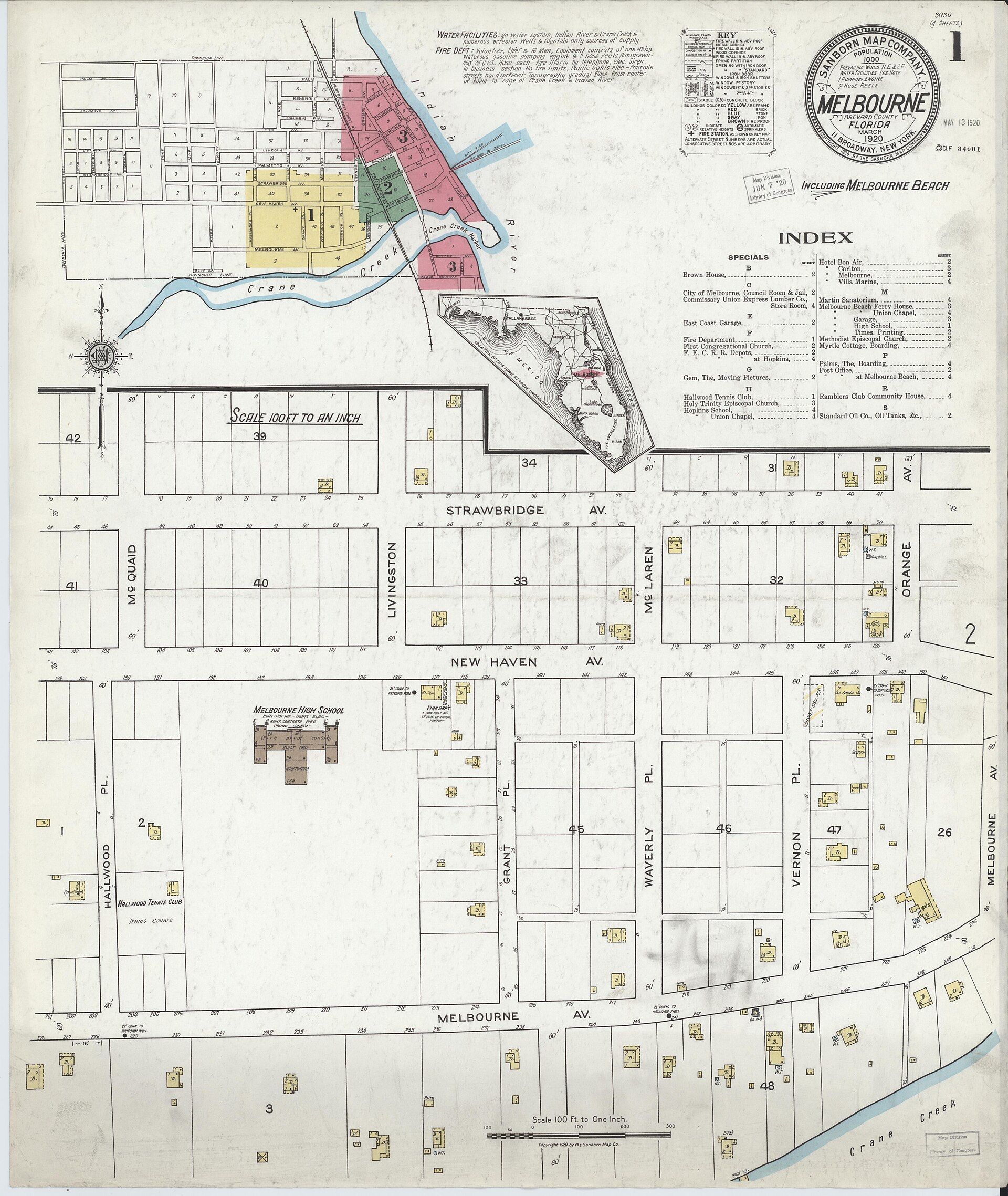
The name puzzles people. “Eau Gallie” is French-Choctaw, mashed together to mean “rocky water” or “stony stream.” It refers to the Eau Gallie River, which has a coquina-limestone streambed in places, exposing the rock at low flow. Gleason’s plat used the spelling “Eau Gallie” from day one. Locals have since called it “Oh Gallie,” “Yo Gallie,” and “Oh-Gal-lee.” The official Florida Department of State page accepts the original Gleason spelling and a current standard pronunciation of “oh-GAL-ee.”
There’s an alternative etymology occasionally cited that traces “gallie” to a Mvskoke (Creek) word, but the Choctaw derivation has wider scholarly acceptance and was Gleason’s stated source. Gleason had spent time in Wisconsin and the Old Northwest and was familiar with French-Indigenous compounds (cf. Eau Claire, Eau Pleine in Wisconsin).
Eau Gallie as a standalone city
The state legislature incorporated Eau Gallie as a town in 1907, nineteen years after Melbourne’s 1888 incorporation. It became a city in 1947. From 1907 through 1969 Eau Gallie operated as a separate municipality with its own mayor, council, schools, post office (until consolidation), police force, and tax base. Its main commercial district was along Highland Avenue (now Eau Gallie Boulevard). Its commercial port was the Eau Gallie River boat basin. Its identity was distinctly different from Melbourne’s: more aerospace-aligned after 1950, more focused on the Air Force missile work at Patrick.
By 1968 the two cities were continuous on the ground. The Eau Gallie Causeway and the Melbourne Causeway both touched the same barrier island. The Florida Tech campus straddled the unofficial boundary. The 1969 merger acknowledged what had already happened.
What the Gleason story doesn’t tell you
Gleason was a complicated figure. The same political connections that let him plat Eau Gallie also funded a level of speculation that produced repeated litigation. The Florida Land Commission of the 1880s pursued him on several patent-validity disputes. He won most of them but spent considerable money defending the holdings.
The other thing the standard biography glosses is the 1876 Dade County electoral returns incident. Gleason, by then living near Fort Dallas (modern Miami) in addition to his Eau Gallie holdings, was responsible for transmitting twenty-eight presidential electoral votes from Dade County in the disputed Hayes-Tilden election of 1876. He forgot to mail them before leaving on a hunting trip. The returns arrived late and did not factor into the contested Florida certification that ultimately handed the presidency to Hayes. Twenty-eight votes in a different year would not matter; in 1876 every Florida vote was load-bearing. Whether the lapse was carelessness or convenient timing depends on which contemporary you read.
What’s accurate: Gleason picked the site. He filed the plat. He donated 2,320 acres for what would have been Florida’s first agricultural college. He recruited the early settlers. He named the place. He died at Eau Gallie in 1902.
Sources
- Florida Department of State, “Florida Facts: Florida History,” accessed 2026-01-07. https://dos.fl.gov/florida-facts/florida-history/
- Florida Memory Project, State Archives of Florida, William H. Gleason papers and correspondence, accessed 2026-01-07. https://www.floridamemory.com/
- Florida Historical Quarterly, various articles on Brevard County early settlement and Gleason’s land dealings, 1922-1965. https://stars.library.ucf.edu/fhq/
- USPS Postmaster Finder, Eau Gallie FL office history. https://about.usps.com/who/profile/history/post-office-finder.htm
- USDA, “Report on the Agriculture of Florida,” 1881.
- Florida Special Acts of 1907, Chapter 5760, “An act to incorporate the town of Eau Gallie in the county of Brevard.”
- “Field Manor,” NRHP nomination, accessed 2026-01-07.
- “William H. Gleason,” Wikipedia, on Gleason’s 1829 birth in Richford, NY; his 1865 Freedmen’s Bureau appointment; the July 7, 1868 lieutenant governorship; the December 14, 1868 removal by Florida Supreme Court ruling; the approximately 16,000-acre Eau Gallie purchase at $1.25 per acre; the 1871 Agricultural College designation with 2,320-acre donation; the 1884 relocation of the college to Lake City; the 1890s Hotel Granada conversion; the 1902 hotel fire; and Gleason’s November 8, 1902 death. https://en.wikipedia.org/wiki/William_H._Gleason
Further Reading
As an Amazon Associate we earn from qualifying purchases.