Front Street and downtown Melbourne before the 1969 merger
Melbourne's pre-merger downtown ran along Front Street and New Haven Avenue, with hardware stores, drugstores, banks, the FEC depot, and a working commercial culture that mostly disappeared in the 1970s suburban shift.
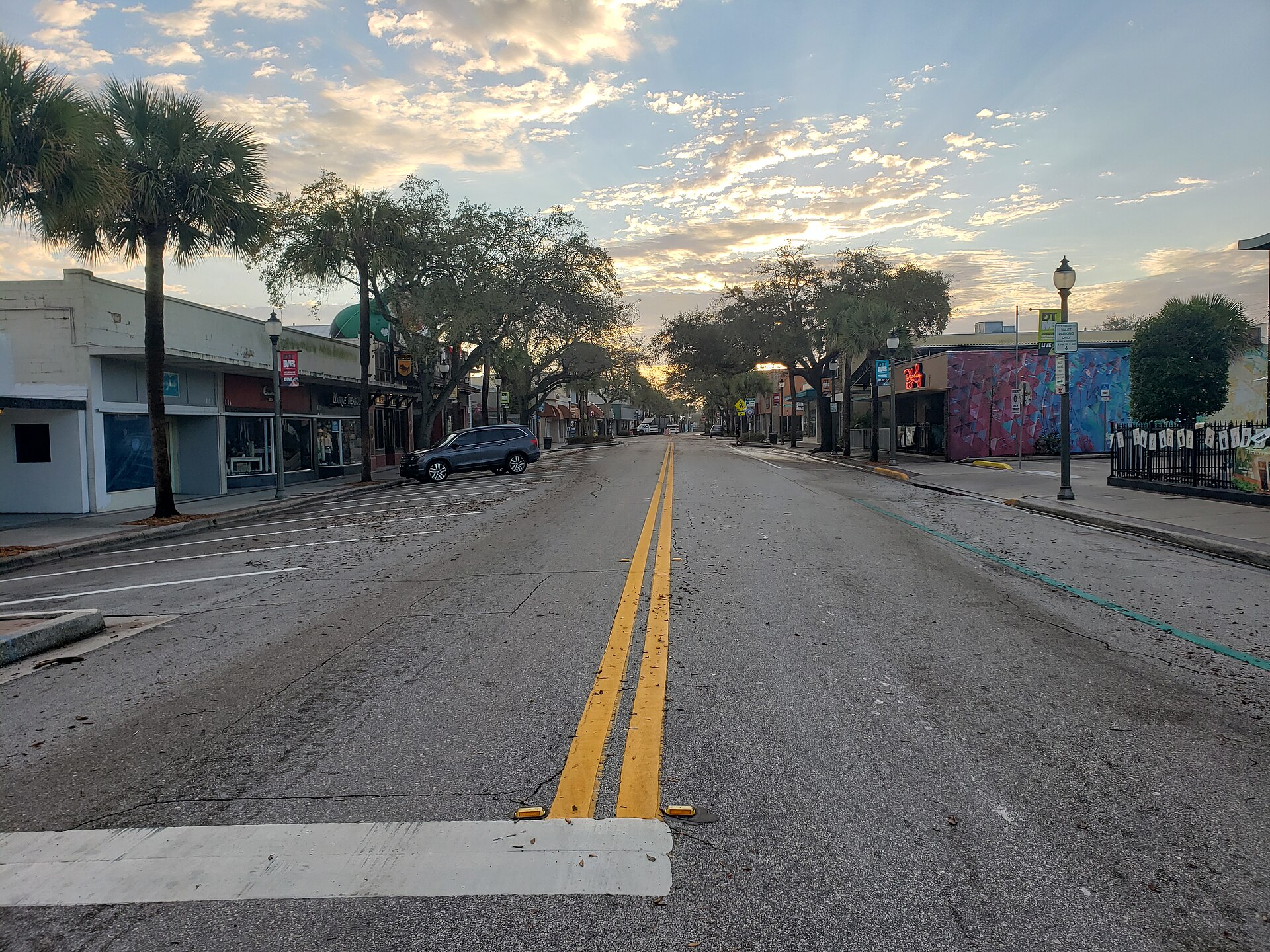
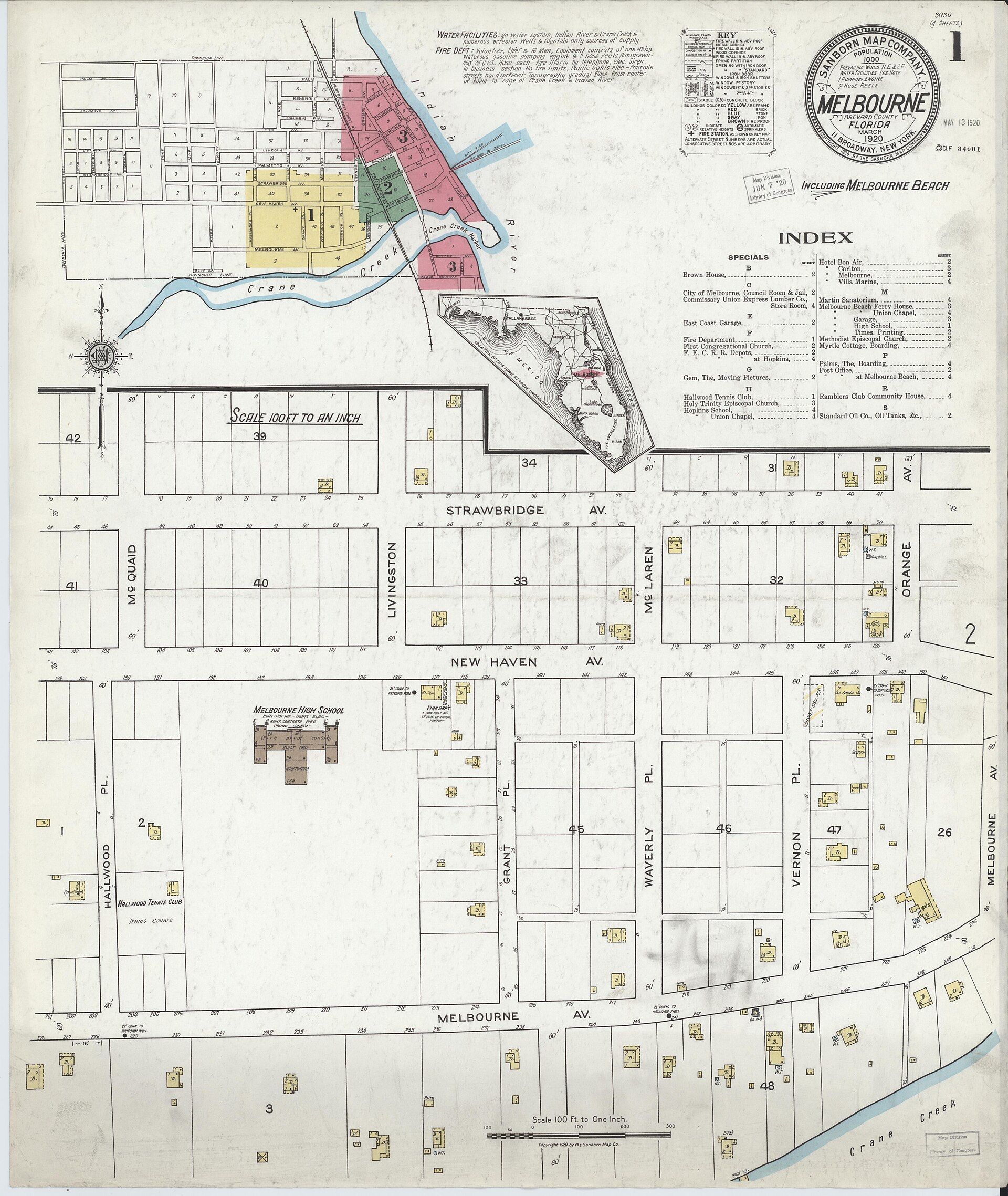
Before the 1969 city merger and well before the suburbanization of the 1970s and 1980s, downtown Melbourne’s commercial core ran along two intersecting streets: New Haven Avenue running east-west, and Front Street running north-south parallel to Crane Creek. The intersection of these two streets, with the FEC depot two blocks west, was the working commercial heart of the city from about 1900 through the mid-1960s. Hardware stores, drugstores, banks, a movie theater, restaurants, professional offices, the post office, the bank, and the city government clustered within five or six blocks. By 1980 most of it had moved to strip malls. Some buildings remain. The pattern of how it worked, and how it dissolved, is worth understanding.
The downtown spatial pattern
A typical pre-merger downtown Melbourne walk:
Start at the FEC depot (1924 brick building, still standing) on Strawbridge Avenue. Walk two blocks east along Strawbridge to the New Haven Avenue intersection. Turn south on Front Street toward Crane Creek. Within four blocks you would pass:
- A hardware store (Newton’s Hardware, operating in various locations on Front Street from the 1910s through 1970).
- The Florida Bank of Melbourne (later First Federal of Brevard), at the intersection of Front and New Haven.
- The Melbourne Times newspaper office (the city’s primary local paper from 1900 through the 1960s).
- Strawbridge Drugs and at least one other pharmacy.
- Schaefer’s Department Store, the largest general retail in downtown through the 1950s.
- A movie theater (the Strand Theatre, opened 1925, operating through 1969).
- The city hall (in various locations through the period; the current city hall is on Strawbridge Avenue).
- The Melbourne post office (moved several times through the period; the present Strawbridge Avenue post office building dates to 1937).
- The Melbourne Public Library (opened 1925, in its own building on East Strawbridge starting in 1937).
- Several restaurants and lunch counters.
- The Crane Creek waterfront with the citrus packing houses, the fish house, and the boat docks discussed in earlier articles.
The walk was about four blocks. Everything you needed to live in Melbourne (groceries, hardware, pharmacy, bank, post, government, entertainment, library) was within those four blocks. That was a deliberate compression characteristic of pre-WWII American small downtowns; it wasn’t unique to Melbourne but it was the pattern.
The commercial culture
Through the 1930s and 1940s, downtown Melbourne had a distinct commercial culture. Most shop owners were Melbourne residents. Most lived in the city limits. Most knew their customers personally. Credit was extended on personal trust. Many businesses ran tabs that were paid monthly or quarterly. The transactional anonymity that’s normal in modern retail was almost unknown.
Saturdays were the busy day. Outlying citrus growers and fishermen came into town on Saturday to shop, do banking, take the family to the Strand Theatre, see the doctor, get the car serviced. The streets were lined with parked cars. The lunch counters at Strawbridge Drugs and the various restaurants ran constantly. The Strand showed two or three different films across the day.
Through the 1940s and into the 1950s, this pattern remained intact. The aerospace boom of the late 1950s and 1960s started to change things by adding a substantial population that hadn’t grown up in Melbourne and didn’t have the personal-trust commercial relationships with the downtown merchants. Newer commercial development on US-1 and on the newly-paved Eau Gallie Boulevard started drawing customers away from the historic core.
The 1960s decline
The decline of the historic downtown started before the 1969 merger but accelerated after it. Three converging pressures:
1. The shopping mall era. The Melbourne Square Mall opened in 1982 on the north side of the city. It was the first regional enclosed mall in Brevard County. It immediately drew apparel, department-store, and specialty retail away from downtown. Schaefer’s Department Store, which had been a downtown anchor since the 1920s, closed in 1984 partly as a result of the mall’s competition.
2. The strip-mall corridor on US-1. Through the 1960s and 1970s, US-1 between Melbourne and the merged Eau Gallie filled in with strip retail centers. Grocery stores, drugstores, hardware stores, and restaurants moved to the highway. Customers followed.
3. The post-merger municipal attention. After the 1969 merger the consolidated city’s planning attention spread across a much larger geographic area. The historic downtown was no longer the city’s only commercial core; it was one of several. Public investment shifted away from preserving the historic core toward facilitating new development.
By 1985, downtown Melbourne had multiple vacancies, declining tenant quality, and increasing structural deferred maintenance. The pattern was typical of small-town American downtowns through the same period.
The historic district designation
The Old Melbourne Historic District was placed on the National Register of Historic Places in 1987, covering a roughly 16-block area centered on the New Haven and Front Street intersection. The NRHP designation:
- Identified about 70 contributing structures.
- Created federal historic preservation tax credit availability for rehabilitation projects.
- Triggered Section 106 review for federal-funded actions that might affect contributing structures.
- Gave the city a formal preservation framework.
The NRHP designation didn’t directly prevent demolitions (private owners could still demolish their own buildings) but it created strong financial incentives for rehabilitation rather than tear-down.
The 1990s and 2000s revival
A modest downtown revival began in the late 1990s and accelerated through the 2000s.
The Henegar Center reopening in 1995 as a performing-arts venue gave the historic core a major cultural anchor and a regular evening-traffic generator. The Henegar’s audience brought people downtown after dark for the first time in decades.
Restaurant openings through the 2000s. A series of locally-owned restaurants opened in the historic core, taking advantage of available historic buildings, the lower rents compared to strip retail, and the cultural anchor of the Henegar.
Special-event programming. The city and downtown business groups developed event programming (Friday Fest, art walks, holiday events) that drew people to downtown for non-shopping purposes.
Residential infill. Some upper floors of historic buildings were converted to lofts and apartments. A small but real downtown residential population emerged.
By the late 2010s downtown Melbourne was viable as an arts-and-dining destination. It’s not the working commercial core it was in 1950, but it’s not the depressed empty street it was in 1985 either. It’s something different: a small evening-and-weekend destination layered over a historic streetscape.
What’s still recognizable
If you walk along East New Haven Avenue today, you can still see:
- The 1919 Henegar building.
- Several pre-WWII brick commercial buildings.
- The 1924 FEC depot.
- The 1937 post office.
- The 1937 public library.
The street pattern is the same. The historic-district boundaries match the pre-1969 commercial core. The names on the streets are the same. What’s mostly gone is the working-class daily commercial activity. The hardware store, the drugstore lunch counter, the small-town newspaper office, the dry-goods store, the local-owned bank: all gone, or replaced by smaller successors that operate on different economic models.
For a Melbourne resident who knew downtown in 1960, the buildings are familiar but the function is different. For a 2026 visitor, it’s a historic district with restaurants and galleries. Both are accurate.
Sources
- City of Melbourne, historical records and downtown revitalization documents, accessed 2026-01-25. https://www.melbourneflorida.org/
- US National Register of Historic Places nomination, “Old Melbourne Historic District,” NRIS 87000926, 1987.
- Florida Memory Project, Melbourne downtown photographs 1900-1970, accessed 2026-01-25. https://www.floridamemory.com/
- Library of Congress, Sanborn Fire Insurance Maps of Melbourne, 1920 and later editions.
- Brevard County property records, downtown Melbourne historic ownership chain documentation.
Further Reading
As an Amazon Associate we earn from qualifying purchases.